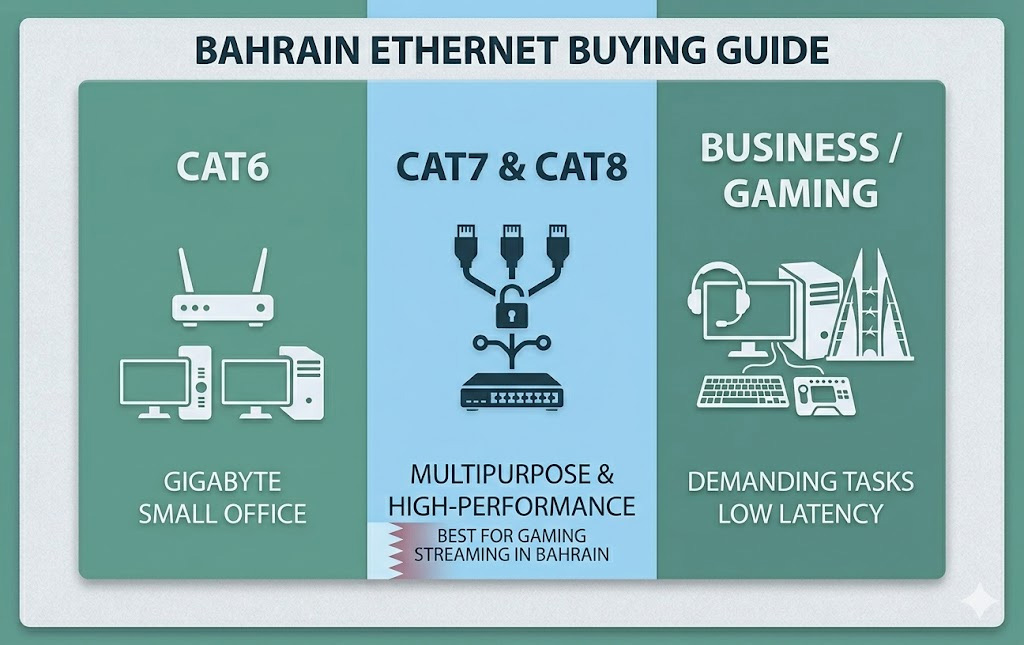
Ethernet Cable Buying Guide for Bahrain: Cat6 vs Cat7 vs Cat8 Explained
Whether you’re setting up a home network in Manama, wiring up an office in Seef, or running cables in a villa in Riffa, choosing the right ethernet cable matters more than most people realize. The cable you pick directly affects your internet speed, your Wi-Fi backbone performance, and even how future-proof your setup will be over the next 5–10 years.
If you’ve been searching for the Cat6 cable price in Bahrain, comparing Cat7 vs Cat8, or wondering which category is overkill for a home setup, this guide breaks it all down — including where to actually buy them locally.
Why Cable Category Matters
Every ethernet cable has a “category” rating (Cat5e, Cat6, Cat6a, Cat7, Cat8) that defines three main things:
- Maximum supported speed — from 1 Gbps up to 40 Gbps
- Bandwidth (frequency) — measured in MHz, which affects signal quality
- Shielding — protection against electrical interference (EMI)
In Bahrain, where most home internet plans from Batelco, stc, and Zain currently top out between 100 Mbps and 1 Gbps, a Cat6 cable will already handle far more than your ISP delivers. But if you’re investing in a structural install — running cables inside walls or ceilings — choosing a higher category future-proofs your setup for years to come.
Cat6: The Standard Choice for Most Bahrain Homes
Cat6 is the most popular ethernet cable in Bahrain right now, and for good reason. It hits the sweet spot between speed, price, and availability.
Speed and Specs
- Max speed: 1 Gbps at full 100m, up to 10 Gbps over short runs (≤55m)
- Bandwidth: 250 MHz
- Shielding: Usually unshielded (UTP)
Best For
Home Wi-Fi mesh systems, gaming PCs, smart TVs, IPTV boxes, small office networks, and CCTV camera installations. If your fiber plan is 500 Mbps or 1 Gbps, Cat6 will deliver every megabit your ISP provides.
Cat6 Cable Price in Bahrain
You’ll typically find Cat6 patch cables (1m to 5m) priced between BHD 1.5 and BHD 5, depending on brand and length. For bulk runs, a 305-meter Schneider Cat6 box is widely available for structural installs at electrical and IT distributors.
Cat6a: The Underrated Middle Ground
Cat6a (the “a” stands for augmented) is often overlooked, but it’s arguably the smartest choice if you want more performance than Cat6 without the price jump of Cat7 or Cat8.
Speed and Specs
- Max speed: 10 Gbps at full 100m
- Bandwidth: 500 MHz
- Shielding: Often shielded (F/UTP or S/FTP)
Best For
Future-proofing your home or office, especially if you’re planning a structured cabling install. Brands like Vention sell Cat6a UTP patch cables widely across local retailers like Microless Bahrain.
Cat7: The “Almost Standard” That Isn’t Officially a Standard
Here’s something most cable buyers don’t know: Cat7 was never officially recognized by the TIA (the body that sets ethernet standards in North America). It’s a real cable with real specs, but it uses non-standard GG45/TERA connectors in its strict form. Most “Cat7” cables sold in Bahrain are actually shielded cables with regular RJ45 connectors — meaning they technically perform as Cat6a in real-world use.
Speed and Specs
- Max speed: 10 Gbps
- Bandwidth: 600 MHz
- Shielding: Fully shielded (S/FTP)
Best For
Environments with high electrical interference, or buyers who want extra shielding for peace of mind. Brands like Ugreen and Trands sell Cat7 cables across Sharaf DG and Lulu in Bahrain.
Cat7 Cable Price in Bahrain
Expect to pay between BHD 3 and BHD 9 for typical patch lengths (2m to 5m).
Cat8: The Future-Proof Beast
Cat8 is the latest officially recognized ethernet cable standard, and it’s seriously fast — but for most Bahrain homes, it’s overkill.
Speed and Specs
- Max speed: 25 Gbps to 40 Gbps
- Bandwidth: 2000 MHz
- Shielding: Fully shielded (S/FTP)
- Maximum effective length: Just 30 meters for full Cat8 speeds
The Catch
Cat8 only delivers its full performance over runs up to 30 meters, and you need Cat8-rated switches and network cards on both ends to actually hit 25–40 Gbps. Without those, you’re effectively paying premium for Cat6a-level speeds.
Best For
Data centers, server rooms, professional studios doing 8K video editing, or enthusiasts running 10GbE/25GbE home networks. Trands Cat8 cables are sold via Sharaf DG and Lulu Hypermarket in Bahrain.
Cat8 Cable Price in Bahrain
Patch cables (2m to 5m) typically range from BHD 4.5 to BHD 9 depending on brand and length.
Quick Comparison Table
| Feature | Cat6 | Cat6a | Cat7 | Cat8 |
|---|---|---|---|---|
| Max Speed | 1 Gbps (10 Gbps short) | 10 Gbps | 10 Gbps | 25–40 Gbps |
| Bandwidth | 250 MHz | 500 MHz | 600 MHz | 2000 MHz |
| Max Length (Full Speed) | 100m / 55m for 10G | 100m | 100m | 30m |
| Shielding | Unshielded (UTP) | Shielded (F/UTP) | Shielded (S/FTP) | Shielded (S/FTP) |
| Best Use Case | Home, small office | Future-proof homes | High-EMI areas | Data centers, 10G+ setups |
| Price in Bahrain (5m) | BHD 2–5 | BHD 3–6 | BHD 4–9 | BHD 5–9 |
Recommended Cable Lengths for Home and Office Setups in Bahrain
The right cable length depends on your space — and Bahrain homes range from compact apartments in Juffair to large villas in Saar. Here’s a practical guide:
Small Apartments (Juffair, Adliya, Seef)
For studio and 1–2 bedroom apartments, you’ll usually need cable runs of 3 to 10 meters. A few short Cat6 patch cables for connecting your router, mesh nodes, and smart TV are usually enough.
Standard Villas (Riffa, Hamala, Janabiya, Saar)
Larger villas typically need 15 to 30 meter runs if you’re wiring rooms back to a central router or modem. For two-story homes, plan for 25–40 meters per run if you’re routing through ceilings or wall conduits.
Office Setups (Seef, Bahrain Bay, Diplomatic Area)
Most small to medium offices need cables of 20 to 50 meters per workstation, with structured cabling running through ceiling trays. For office installs, always buy from a 305m bulk roll and crimp ends to length — it’s cheaper and cleaner.
General Rule of Thumb
- Always buy 1–2 meters longer than you think you need (for slack).
- Avoid runs longer than 90 meters per cable; if needed, use a network switch as a midpoint.
- For Cat8, never exceed 30 meters or you’ll lose its speed advantage.
Pro Tip: Buying in Bulk
If you’re wiring an entire home or office, skip the patch cables and buy a 305-meter (1000 ft) box of Cat6 or Cat6a from a distributor. Brands like Schneider Electric, D-Link, and Commscope are commonly stocked in Bahrain, and you’ll get a far better per-meter price than buying individual lengths.
How to Choose the Right Cable: A Simple Decision Guide
Here’s a quick way to pick the right cable for your situation:
- You have a basic home internet plan (under 500 Mbps): Cat6 is more than enough.
- You have a 1 Gbps fiber plan from Batelco, stc, or Zain: Cat6 or Cat6a will deliver full speed.
- You’re wiring a new home or villa for long-term use: Go with Cat6a — it’s affordable and supports 10G.
- You’re in a high-interference environment (industrial, near elevators, etc.): Pick Cat7 for the extra shielding.
- You’re building a 10G+ home lab or running a small server: Cat8 is worth it — but only for runs under 30 meters.
- You’re a content creator handling huge files locally: Cat6a or Cat8, depending on your switch capabilities.
Common Mistakes to Avoid
1. Buying Cat8 for a 100 Mbps Connection
Your speed is limited by the slowest device in the chain. If your modem only supports 1 Gbps, Cat8 won’t make your internet faster.
2. Ignoring Cable Length Limits
Going beyond the recommended length kills performance. A 60-meter Cat8 cable won’t deliver 25 Gbps — you’ll be lucky to get half that.
3. Falling for “Cat7” Marketing
Many “Cat7” cables sold online are essentially Cat6a with extra shielding. If you’re paying double for “Cat7” performance, make sure it’s worth it. For most users, Cat6a is the better value.
4. Buying Cheap Aluminum-Core Cables
Some budget brands use copper-clad aluminum (CCA) instead of pure copper. These cables are cheaper but have higher resistance, lower speeds, and can even be a fire risk. Always look for “100% pure copper” or OFC (Oxygen-Free Copper) on the listing.
5. Skipping Shielding in Office Environments
Offices with lots of electrical equipment, fluorescent lights, or HVAC systems benefit from shielded cables (F/UTP or S/FTP). Unshielded Cat6 may pick up interference and drop speeds.
Final Verdict: Which Ethernet Cable Should You Buy in Bahrain?
For most Bahrain homes and small offices, here’s the simple answer:
- Best for everyday use: Cat6 — affordable, fast, and widely available.
- Best value for future-proofing: Cat6a — supports 10 Gbps with great shielding.
- Best for niche needs: Cat7 (high-EMI areas) or Cat8 (data centers and 10G+ networks).
Unless you have very specific high-speed networking needs, Cat6 or Cat6a will serve you perfectly — and you’ll save money for things that actually impact your speed, like a better router or mesh Wi-Fi system.
Frequently Asked Questions
What is the average Cat6 cable price in Bahrain?
Cat6 patch cables (1m to 5m) typically cost between BHD 1.5 and BHD 5. Bulk 305m rolls range from BHD 30 to BHD 80 depending on brand and shielding.
Is Cat8 worth it for home use in Bahrain?
For most Bahrain homes, Cat8 is overkill. Internet plans here cap at around 1 Gbps, and Cat8’s full speed only matters in 25–40 Gbps networks. Cat6a is a better value for almost all home users.
Where can I buy bulk ethernet cable in Bahrain?
For 305-meter rolls of Cat6 or Cat6a, check Shopkees Bahrain, Advanti, and electrical distributors in Sitra and Salmabad. Schneider, D-Link, and Commscope are common brands.
Can I use Cat8 with my regular router?
Yes — Cat8 is backward compatible with all RJ45 ports. But your speed will be limited by the router. To get Cat8 speeds, you need a 25G or 40G capable switch and network card.
Does cable length affect internet speed?
Within recommended limits, no. But beyond 100 meters (or 30 meters for Cat8), signal quality drops and speeds suffer. Always stick to the cable’s rated length.
Is shielded cable necessary in Bahrain homes?
Usually no, unless you live near an industrial area, large transformer, or have heavy electrical equipment in your home. Standard UTP Cat6 works fine for most apartments and villas.