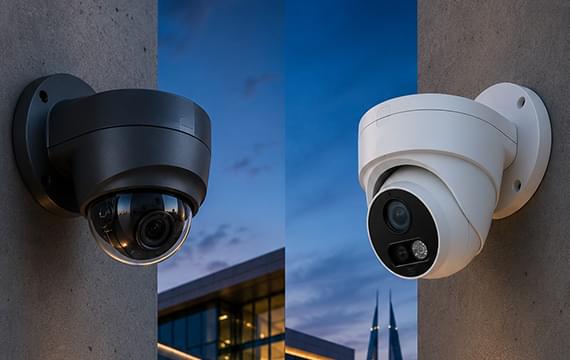
If you are planning a new commercial surveillance deployment or upgrading an existing network infrastructure, two global industry leaders will inevitably dominate your search: Hikvision and Dahua. Together, these engineering giants command the lion’s share of the global security market.
Because both brands offer massive catalogs covering everything from entry-level IP cameras to enterprise network video recorders (NVRs), they often look identical on a spec sheet. However, key differences in hardware focus, software engineering, and regional value-to-cost ratios will determine which is the best CCTV brand Bahrain businesses should deploy. This direct CCTV comparison 2026 breaks down how these powerhouses stack up across critical operational categories.
1. Camera Quality and Night Vision Technology
Both brands deliver outstanding daytime clarity with resolutions reaching up to 4K (8MP and 12MP), but their proprietary imaging technologies diverge when handling challenging, low-light environments.
- Hikvision (The Low-Light Champion): Hikvision relies on its flagship ColorVu 3.0 and DarkFighterX technologies. By combining massive lens apertures, ultra-sensitive image sensors, and soft, warm built-in supplement lights, Hikvision cameras capture vivid, full-color video in near-total darkness without turning to grainy infrared (black-and-white) modes.
- Dahua (The High-Value Contender): Dahua counters with its competitive Starlight and WIZColor technologies. While Hikvision holds a very slight, narrow edge in extreme pitch-black conditions, Dahua delivers incredibly crisp, balanced color exposure in dim urban settings and parking lots at a more approachable price point. Furthermore, Dahua has traditionally led the mid-range market by integrating high-quality, built-in environmental microphones into standard models.
2. Artificial Intelligence and Video Analytics
Surveillance has evolved from passive recording to active, automated scene analysis. Both manufacturers have poured heavy R&D into embedded deep-learning processors to filter out up to 90% of environmental false alarms (like wind, rain, or stray animals).
- Hikvision AcuSense & DeepinMind: Hikvision’s AcuSense algorithm excels at human and vehicle classification, letting IT teams instantly filter hours of recorded playback by target type. At the enterprise level, its DeepinMind NVR series offers incredibly fast, highly accurate facial recognition, behavior analysis, and multi-channel structural filtering.
- Dahua WizSense & WizMind: Dahua’s AI suite features WizSense and WizMind. While its core human/vehicle detection matches Hikvision’s accuracy, Dahua integrates highly flexible features like AcuPick (advanced target searching) and Automatic Number Plate Recognition (ANPR) down into lower, mid-tier NVR lines.
- Active Deterrence Features: If your goal is crime prevention rather than forensic review, the brands use different defensive tactics. Dahua is renowned for its TiOC (Three-in-One Camera) line, which uses flashing, police-style red and blue strobe lights alongside customizable audio sirens to actively scare off intruders. Hikvision’s Live-Guard equivalent counters with intense white flashing strobe lights and sirens.
3. Mobile App and Remote Software Experience
A security system is only as good as the software interface used to manage it daily.
- Hikvision (Hik-Connect & iVMS-4200): The Hik-Connect mobile app is a stable, highly mature, enterprise-grade utility that works smoothly even over slower mobile data connections. For desktop management, its iVMS-4200 software is incredibly powerful but features a steeper learning curve meant for trained IT administrators.
- Dahua (DMSS & SmartPSS Lite): Dahua’s DMSS mobile app has received major UI updates, yielding a snappy, modern dark-mode user experience with highly intuitive push-notification menus. On the desktop, Dahua’s SmartPSS / DSS platform is widely considered more user-friendly and easier to master for non-technical users.
4. Pricing and Total Cost of Ownership
When compiling hardware quotes, the financial divide in the Hikvision vs Dahua matchup becomes apparent:
- Dahua consistently undercuts Hikvision by 15% to 20% on comparable hardware tiers, particularly in the mid-range AI and active-deterrence IP camera categories. It provides exceptional specifications-per-dollar, making it the preferred choice for budget-conscious small-to-medium businesses (SMBs).
- Hikvision commands a premium price tag. However, it offsets this upfront hardware cost with a massive, cohesive product ecosystem that scales effortlessly to support hundreds of channels across complex, enterprise-level infrastructure projects.
5. Warranty and Support in Bahrain
Both brands enjoy a powerful local footprint across the Kingdom of Bahrain, making them highly reliable options for long-term deployments. Authorized regional distributors provide standard 2-to-3-year hardware warranties on professional IP lineups.
Because Hikvision maintains a slightly larger certified local system integrator network in the region, getting on-site engineering support, immediate firmware patches, and direct hardware replacements is generally seamless. Dahua’s presence is equally robust among local trade professionals, but it relies on an open-platform system design that allows third-party software tools to easily manage the equipment if you ever choose to switch local service providers.
The Final Verdict: Which Brand Wins in 2026?
Ultimately, you cannot go wrong with either market leader, as both systems provide the raw reliability required for commercial setups. Your choice should depend entirely on your specific organizational priorities:
- Choose Hikvision if: You require the absolute best full-color night-vision clarity in near-pitch darkness, need an elite facial recognition ecosystem for an enterprise facility, or prefer deploying a deeply integrated unified ecosystem.
- Choose Dahua if: You want to maximize your budget-per-channel, require active-deterrence flashing strobes and sirens to protect perimeter yards, or want built-in audio recording on standard mid-range cameras without paying extra.
Regardless of the brand badge on the chassis, your system’s final stability relies heavily on professional network topology design, clean PoE cabling, and correct configuration to meet Bahrain’s strict regulatory guidelines.